WORKS
100 PIECES OF DEBRIS, 1981
100 metal on wood pieces / Various forms and sizes from 3 cm to 1 m
The explosion of a bomb placed in a parked car destroyed the southern façade of a building in construction that I was supervising at the time. Having lived the impact and the dispersion of debris in various forms provoked the basic idea for this artwork.
This art installation consisted of 100 pieces of burnished recycled aluminum on wood. 100 rocks, glass scraps and splinters with their respective shadows were placed over two L-shaped walls of 10 x 10 linear m x 1.8 m in height, creating a great horizon of debris. The corner provided depth and perspective to the dazzling landscape. All the pieces were autonomous, they could be placed individually or in groups. They had a life of their own.
The acts and ideas of violence could be materialized through the avant-garde conceptual resource. This installation was taken down and is unrepeatable. I granted the Order of the Debris to 60 friends to whom I gave each one piece.
View of the show 100 Pieces of Debris. A selection of Pieces of Debris. 100 different pieces were exhibited in the original show.

View of the show 100 Pieces of Debris A selection of Pieces of Debris. 100 different pieces were exhibited in the original show.

100 different pieces were exhibited in the original show.
View of the show 100 Pieces of Debris A selection of Pieces of Debris. 100 different pieces were exhibited in the original show.


ART OF RESISTANCE, 1997
Immersive art installation / 11 oil-on-canvas paintings of several sizes
My friend Fernando González Davidson, Guatemala's Ambassador to Japan at the time, facilitated my visit to Tokyo where I simultaneously presented several works of art. These pieces had symbolic shapes that highlighted an aesthetic synthesis of the violent agony and social rupture we experienced at the end of the 20th century.
Facade, installation. Motivated by the memory of the regrettable 1980 burning of the Spanish Embassy in Guatemala. On a white wall, I placed two pieces of wood, as window lintels and sills, to frame three oil-on-canvas paintings of windows in flames.
Death Sentence, installation. On a white wall, three white canvases, without frames, depicted the impact of the bullets from the execution of three individuals whose silhouettes were outlined on the floor by means of white lines, in front of each canvas.
Lastly, an installation of five canvases that spoke of the needs and sorrows of the people: on one wall were We Want Justice, We Want Corn, We Want Beans and We Want Land. [T.N: These titles were written as people in rural areas speak since Spanish is not their mother tongue]. On another wall was Fossil, a skeleton emerging from the muddy clay of one of the many anonymous mass graves.
IN FLAMES, 1992
Immersive art installation / 13 oil-on-canvas paintings of various sizes
The force and expressive formality of diverse flaming contents falling on a tropical, national horizon located and universalized the artworks born from my preoccupation about human problems, collective violence, the spread of polluting industries, systematic style destruction, a devastated Earth…
This installation consisted of four oil-on-canvas paintings of large format depicting human beings: Homo sapiens, Homo faber, Homo architectus and Homo naturabilis. These human figures were fractioned, in flames, falling within a blue and white landscape.
The exhibit also included three triptychs of medium size. The first showcased several geometric figures in flames, suggesting a fractioned Earth. The second depicted blazing architectural details, suggesting the chaos of our current civilization, and the third, showed our national currency The Flaming Quetzal, as well as a depiction of the hunger suffered by the people in The Flaming Beans and The Flaming Corn. This last piece showcased a third-world corncob, naked, without grains, its husks turned like flaming vanes. This phallic figure was shown falling within a blue and white horizon, representing the Guatemalan national flag.
As Elisa Fernández Rivas, a renowned Guatemalan art critic, would say, these artworks show a synthetic abstractionism.


EARTH INHABITANTS, 1968
Immersive art installation / 16 enameled wood pieces, irregular shapes, different sizes
After experiencing the 1967 World Fair in Montreal for two weeks, I developed this first immersive art installation that was more coherent and comprehensive.
Earth Inhabitants was a series of enameled wood pieces in puzzle-like shapes, free of the square format, which interlocked. The figures were made of cedar wood planks that were cut, scored, and painted in various industrial colors. When mounted on the wall of the exhibit hall, the artwork formed a circle around the planet Earth, represented by a sphere 3 m in diameter with six round holes through which light beams projected towards the walls. The sphere was installed off-center causing the light beams to become larger over the walls that were located the farthest. As part of the installation experience, the hall lights were turned off while the sphere slowly rotated projecting rays of red and yellow light, in a circular fashion, creating a dynamic mood of movement and speed within the darkness. The audience sat on the floor listening to a ten-minute recording of urban noises, a symphony of squeaks and honks that ended with a plane crash. When the recording ended, the planet stopped rotating, the room lit up, and everyone, enthusiastically, applauded.
During the three-week run of the exhibit, the show was repeated every day at 6:00 p.m., giving students the opportunity to enjoy the experience.
Photo description:
Panoramic views of the exhibition
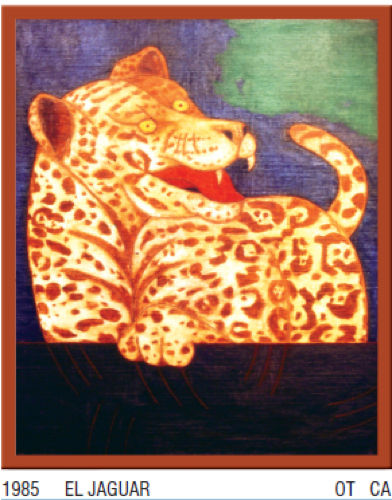
GUATEMALAN FAUNA, 1985
Immersive art installation / 14 oil-on-canvas paintings 70 x 67 cm
After I created Parisian Fauna, the logic step was to work on a similar series with a Guatemalan theme. Using geometric figures of various colors, each painting presented a bird or beast of Guatemalan fauna, grouped symbolically. On one side were the good characters, those that build, and on the other, were the bad ones, those that destroy.
As part of the installation, I placed, on the gallery walls, non-pictorial elements made of corrugated cardboard. They consisted of a series of green dots of important size, with their respective black shadows which I installed below and to the right of each painting, simulating punctuation features. As these elements were incorporated into the artwork, they energized the whole experience of the exhibit with periods or ellipses creating in the spectator a sensation of magic realism, as if the paintings were part of a visual phrase. The sum of it all gave an immersive turn to the artwork as it converted the painting series in… a punctuated phrase.
The Monkey
The Jaguar
Kukulkán
The Great Quetzal
The Wolf
Quetzalumán
King Quetzal
The Female Quetzal